

 Justin Brackett · October 23, 2026
I’ve been doing church YouTube for a long time.
Not from the outside. From the inside.
I ran digital at Seacoast Church across 14 campuses. I led Joel Osteen’s YouTube at Lakewood Church. And every week, my team at digifora works on church YouTube channels like LifePoint Church, Turning Point with Dr. David Jeremiah and Convoy of Hope.
So when a pastor tells me, “Our YouTube just isn’t growing,” I don’t hear a content problem.
I hear a visibility problem. (I wrote about that in YouTube for churches.)
The sermon is fine. Usually it’s better than fine. The people who need it just can’t find it.
The short answer: your church YouTube isn’t growing because the people who need your sermons can’t find them. It’s almost always 1 of 5 things: the channel has no clear job, the titles are written for the series, the packaging is an afterthought, you only post the full service, or you post when you get to it.
Sunday ends. Someone uploads the stream.
Title: Sunday Service, November 2.
Thumbnail: whatever frame YouTube grabbed. Usually the pastor mid-blink.
Your team put 20+ hours into that message. Study. Writing. Rehearsal. Worship. Production.
And it goes up labeled like a file in a cabinet.
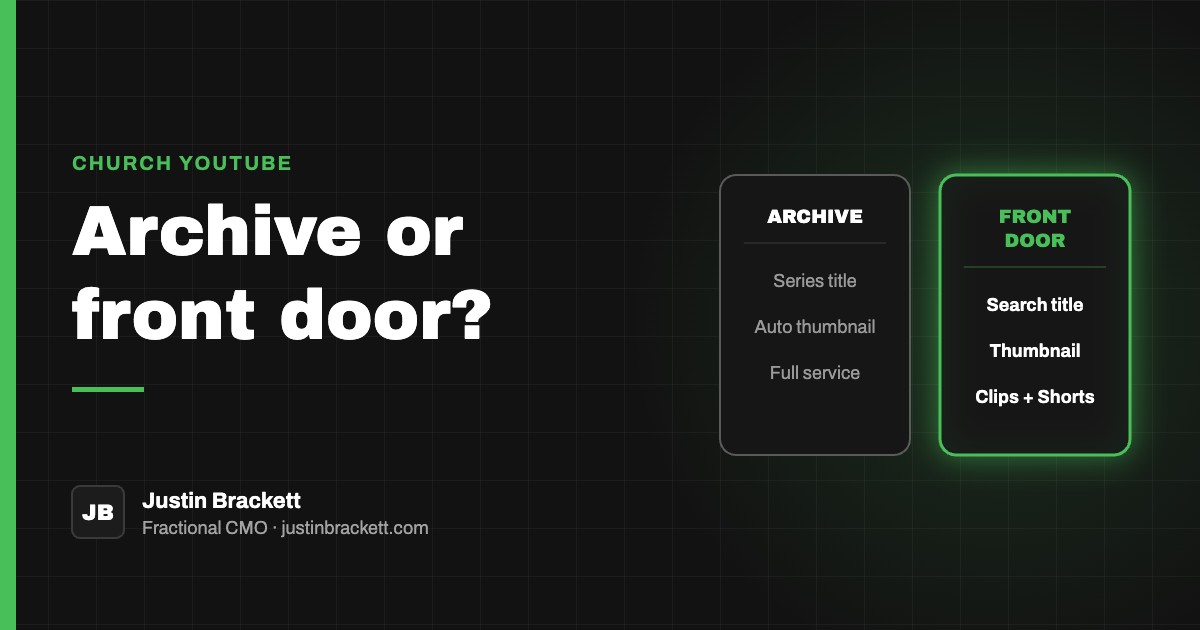
That’s not a church YouTube channel. That’s an archive.
Archives don’t grow. Front doors do.
In almost every channel I look at, it comes down to 5 things.
Not the algorithm. Not the budget. Not your pastor’s preaching.
Let’s take them one at a time.
Most don’t. And without one, nothing else on this list works.
Ask your team what your church YouTube channel is for.
You’ll get 5 different answers. Or a shrug.
Is it for members who missed Sunday? For people in your city looking for a church? For the person at 2am typing “how do I know God is real”?
All 3 are good. They’re not the same.
Pick 1 first. Everything else follows it.
If your titles name the series, they’re written for your members. To get found, name the problem the sermon answers.
“Unshakable, Part 4.”
Your people know what that means. A stranger doesn’t.
People don’t search for your sermon series. They search for the thing keeping them up at night.
How to Trust God When Your Plans Fall Apart.
How to Stop Worrying About Money.
What to Do When God Feels Far Away.
Same sermon. Different front door.
Keep the series name. Just put it after the topic. More on that in YouTube SEO for churches.
Your title and thumbnail are the first thing anyone sees.
If YouTube picks your thumbnail for you, you’ve lost the click. Before anyone hears a word.
A custom thumbnail. A face. A few words.
A description that says what the message answers, plus your church name and city.
Chapters on anything over 10 minutes.
None of that costs money. It just costs attention.
The full service matters. It serves the people who already know you.
But a stranger isn’t pressing play on 75 minutes.
YouTube gives every channel 3 tabs: Live, Videos and Shorts. Use all 3.
The full service lives in Live.
The sermon, edited, with a real title, goes in Videos.
Clips and Shorts are where new people actually meet you. Here’s how to turn 1 sermon into a week.
One Sunday can carry a whole week.
Consistent enough that your people and YouTube know when to expect you. Same days. Every week.
Consistency isn’t a production problem.
It’s a calendar problem.
Somebody has to own Monday.
No. It needs the right 25. But you only meet them if a lot more people see you first.
I hear this one a lot:
“Our live stream doesn’t need thousands of people. We just need the 25 who want to be part of our church.”
I love the heart behind it.
But those 25 people aren’t sitting around waiting for you. They’re strangers right now. They’re on YouTube typing questions, not your church’s name.
You don’t get the right 25 by staying hidden.
You get them by showing up. By being seen. Week after week.
Skip that, and the 25 you get are the people already in your pews. Watching from the couch.
Score your church YouTube channel. Be honest.
Every “no” is a leak.
Fix them in that order. Start with the job. Then track the numbers that matter.
Deciding what church YouTube is for isn’t the media team’s job.
It’s leadership’s.
The weekly work? That can be a volunteer, a staff member or a team like ours. But somebody has to own it. Here’s who should run your church YouTube.
Show up. Be seen. Earn the click.
Then bring them home.
If you want help figuring out what YouTube should do for your church, let’s talk.
If you need a team to do the weekly work, that’s what we do at digifora.
Expect months, not weeks. Better titles and thumbnails can lift clicks within a few weeks. Growth from search and recommendations builds over several months of posting on the same days.
Yes. YouTube doesn’t rank churches by size. It ranks videos by whether people click and keep watching. A small church with clear titles and consistent clips can outgrow a large church that only posts its archive.
Not as a category. Church videos are judged like every other video, on clicks, watch time and whether viewers come back. Channels that look suppressed are usually channels with weak titles and packaging.
Both, for different jobs. YouTube gets you found by people who don’t know you yet. Your website and app are where people who already know you go deeper.
Fewer than you think. Subscribers are a lagging number. Impressions, click-through rate and returning viewers tell you sooner whether the channel is working.

Justin has a proven track record of delivering results for clients across a range of industries, including hospitality, technology, retail, and non-profit.
