


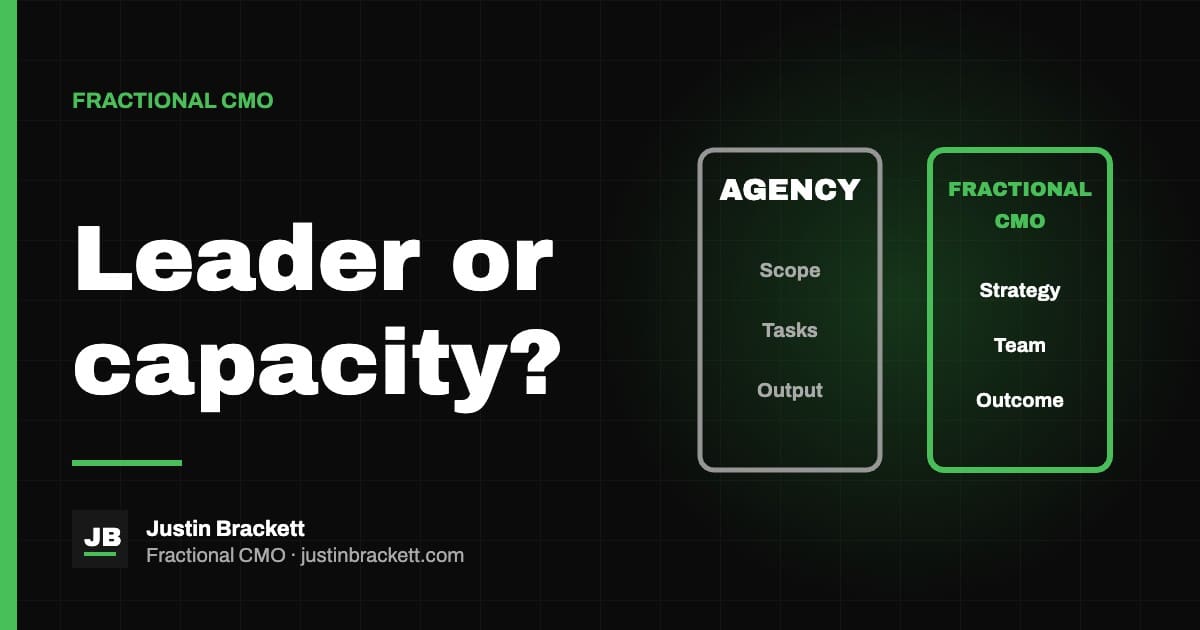
Fractional CMO
A fractional CMO owns your marketing strategy, team and scoreboard. A marketing agency executes a defined scope of work. I’m Justin Brackett, a fractional CMO since 2008 and the founder of digifora, and the honest answer is that most organizations asking this question need both. The mistake is hiring one to do the other’s job.
 Justin Brackett · Fractional CMO · Updated October 22, 2026
Fractional CMO vs marketing agency assumes the two are substitutes. They aren’t. A fractional CMO is a leadership hire. An agency is a capacity hire. Asking which one you need is like asking whether your church needs an executive pastor or a worship team. The answer depends on what’s missing, and it is almost never the same thing.
The real question behind fractional CMO vs marketing agency is: what is your marketing problem, leadership or labor?
An agency executes. You give it a scope (run the ads, send the emails, produce the videos, fix the SEO) and it delivers against that scope. Good agencies deliver it well. digifora runs paid media, email automation, creative, SEO and YouTube for churches, nonprofits and growth-stage companies, and the team is good at it.
What an agency does not do, with rare exceptions, is own your outcome. It reports on activity: impressions, open rates, videos published. Whether those activities add up to attendance, giving or revenue is a question the agency is usually not positioned to answer, because the agency doesn’t sit in your leadership meeting and doesn’t control the other 70% of your marketing it wasn’t hired to touch.
That isn’t a criticism of agencies, and it isn’t the whole fractional CMO vs marketing agency answer. It’s the shape of the relationship. An agency executes inside a system. If there’s no system, it executes inside a vacuum.
A fractional CMO owns the system. Strategy, message, channel choices, budget, vendor direction, the weekly rhythm and the scoreboard the CEO reads. The role is executive, 1 to 2 days a week, and the output is decisions, not deliverables.
I learned the fractional CMO vs marketing agency difference the hard way, from the inside. At Lakewood Church (2018 to 2020), I ran a digital program sending 1M emails a day at a 49% open rate. The agencies and vendors we used were competent. What made the numbers hold was that one person owned the message, the cadence and the scoreboard, and every vendor worked from that. Remove that role and you have 6 competent vendors doing 6 different things.
At MAP International, I led the rebrand of a $1B organization. A rebrand is exactly the kind of project where an agency without an executive owner produces a beautiful identity that nobody inside the organization adopts. The reason that one held was that the people executing it reported to the person who designed it.
Here is how I settle fractional CMO vs marketing agency with a new client. Hire a fractional CMO first if any of these are true:
Hire an agency first if any of these are true:
If you read both lists and said yes to items on each, fractional CMO vs marketing agency is the wrong frame. You need both. That’s most organizations between $2M and $100M, and it’s the gap I built digifora to close.
The fractional CMO vs marketing agency handoff disappears. When I set the strategy and digifora runs it, there’s no consultant on one side and agency on the other, each explaining why the other is the problem. One executive owns the outcome. One team does the work. Both report to you.
That’s how Ruth’s Chris worked. I set the strategy and digifora ran the paid media: $800,000 in ad spend at a 4.5x return. The strategy didn’t degrade in translation, because there was no translation.
You don’t have to hire digifora to work with me. I lead internal teams and existing agencies regularly, and the system I design works with any vendor. But if you’d rather have one accountable relationship for both the thinking and the doing, that’s what the combination is for.
Here is how the fractional CMO vs marketing agency decision played out for a composite client, a $20M multisite church with 4 campuses and a 3-person communications team.
The church had worked with 2 agencies in 3 years. Both produced good creative. Both reported impressions, video views and email open rates every month. Attendance was flat and first-time guest return rate had never been measured. The executive pastor’s conclusion was that they needed a third, better agency. The actual problem was that nobody owned the outcome. The agencies executed what they were asked for, the communications team produced what the ministries requested, and no one was deciding what the church should be saying or measuring whether it worked.
In fractional CMO vs marketing agency terms, the church had been solving a leadership gap with capacity hires, twice. The third attempt would have produced the same result.
What changed: a fractional CMO engagement at 1 day a week. The first 30 days produced a diagnosis and a scoreboard: first-time guests, return rate, next-step conversions, giving units, email reach. The second 30 settled one message across 4 campuses and cut channels from 7 to 3. The existing agency kept the account and started working from a brief. Within 2 quarters, first-time guest return rate went from unmeasured to 31%, and the communications director described the weekly scoreboard meeting as the first time she knew whether her work was working.
The agency did not get worse or better. It got direction. That is the fractional CMO vs marketing agency answer in one line: the agency is the engine, and an engine without a driver goes nowhere in particular.
Decide fractional CMO vs marketing agency by what’s missing. If what’s missing is leadership, start with fractional CMO leadership and read what the role covers, what it costs and how I run it. If what’s missing is capacity and the direction is already clear, start with the team at digifora.com. And if you’re not sure which, book a strategy call. Working that out is the first thing I do.
Keep reading: What a fractional CMO does, what it costs, and when you need one

Justin has a proven track record of delivering results for clients across a range of industries, including hospitality, technology, retail, and non-profit.
