


Marketing Systems
Scattered marketing is what happens when an organization builds its marketing one tactic at a time, under deadline, by different people, and never connects the pieces. I’m Justin Brackett, a fractional CMO since 2008. The fix isn’t more effort or a better agency. It’s a marketing operating system, and most organizations I meet have never had one.
 Justin Brackett · Fractional CMO · Updated October 22, 2026

When marketing feels scattered, it looks busy. That’s what makes it hard to diagnose. The team is working, the calendar is full, things are getting published. And every month starts from zero.
Here are the 6 symptoms of scattered marketing I see most often:
If you recognized 3 or more, your marketing feels scattered for a reason. That’s not a judgment on the team. It’s a description of the structure.
Marketing feels scattered because marketing grows faster than process. An organization hires a communications director, who does good work. Then it adds a social media coordinator, then an email tool, then an agency for ads, then a video freelancer. Each decision was reasonable. Together they’re 5 pieces that were never designed to fit, managed by a person who is also expected to produce.
The result is marketing that depends on people instead of process. When the people are at their best, it works. When someone leaves, gets sick or burns out, the whole thing wobbles. That’s the real cost when marketing feels scattered: it’s fragile.
I watched the opposite from the inside. At Lakewood Church (2018 to 2020), the digital program sent 1M emails a day at a 49% open rate. At that volume, scattered marketing isn’t an option. The reason the numbers held wasn’t talent, though the team was talented. It was that the message, the channels, the follow-up, the weekly rhythm and the scoreboard were settled in advance. The team executed inside a structure instead of inventing one every Monday.
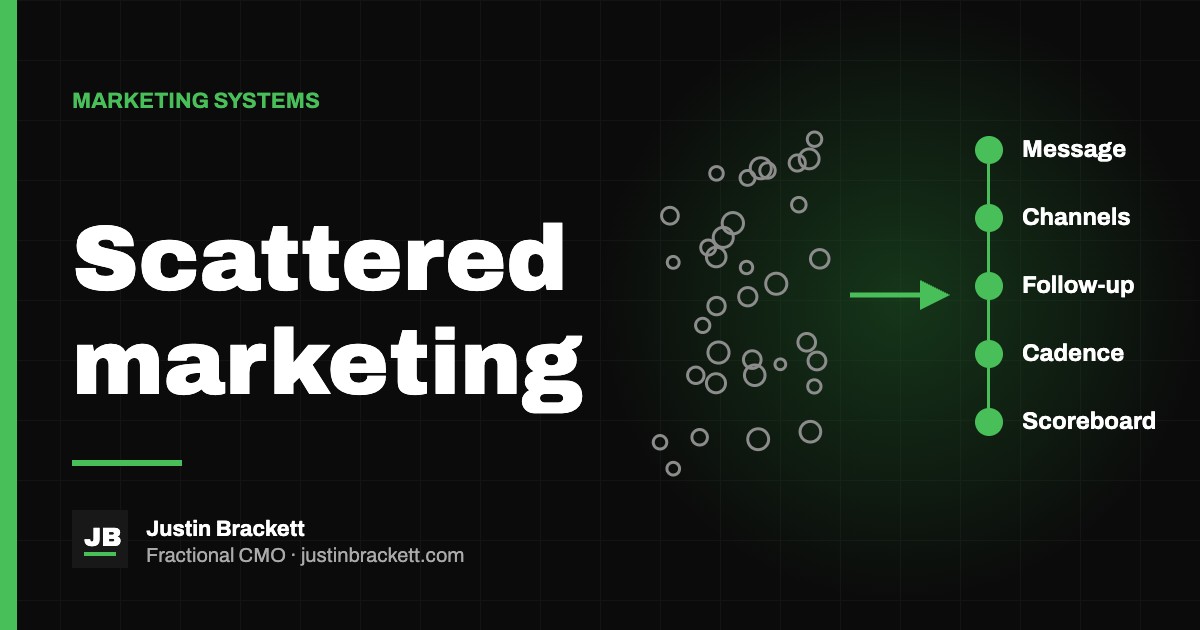
A marketing operating system answers 5 questions before the week starts: what do we say, where do we say it, what happens after someone responds, when does each piece run, and how do we know it worked. Those are the 5 parts: message, channels, follow-up, cadence and scoreboard.
Here’s what changes when they’re in place and marketing that feels scattered becomes a system:
That last one is the whole reason to do this. Predictable growth isn’t a bigger budget. It’s a structure that produces similar results from similar inputs, month after month.
Because the agency inherits the scattered marketing structure. A good agency executing inside a vacuum produces good tactics with no system around them. The ads are well built. The emails are well written. The results are still unpredictable, because the pieces still don’t connect.
I say this as someone who owns an agency. digifora runs paid media, email automation, creative, SEO and YouTube for churches, nonprofits and growth-stage companies, and it does the best work when the system already exists. That’s why I design the system first, as fractional CMO, and then let the team run it. When digifora ran paid media for Ruth’s Chris ($800,000 in ad spend at a 4.5x return), the number came from the strategy being settled before the first dollar was spent, not from the ads alone.
The same held at MAP International. Leading the rebrand of a $1B organization is the kind of project that scatters instantly without an owner. It held because one person designed it and the people executing reported to that person.
Here is a composite of what I find in the first 30 days with a client whose marketing feels scattered. The details change; the shape does not.
A $12M nonprofit with a communications director, a part-time social media coordinator, an email platform nobody fully owns, and an agency hired 2 years ago for a year-end campaign that is still invoicing monthly. The executive director approves every graphic. Year-end raised 38% of annual revenue, and 61% of the donors it acquired did not give again. The website says one thing about the mission, the appeal letter says another, and the Instagram bio says a third.
Nobody on that team is lazy. The director works 55-hour weeks. The agency delivers on time. And marketing feels scattered because the 5 parts were never connected: there is no single message, the channels were chosen by habit, follow-up is a thank-you letter and then silence until the next appeal, the only cadence is Q4, and the dashboard is 3 separate reports from 3 separate tools.
The fix took 90 days and no new hires. One message, written with the development director in the room so both teams would use it. Channels cut from 6 to 3. A 3-touch follow-up sequence for new donors that runs automatically. A weekly 30-minute scoreboard meeting with 6 numbers. The agency kept its contract but started working from the message brief instead of its own creative instincts. By the next year-end, donor retention was up 14 points and the executive director had stopped approving graphics.
That is the whole argument. When marketing feels scattered, the fix is almost never more effort or a different vendor. It is the structure that makes the effort you already have compound.
Don’t start with tactics. If marketing feels scattered, the problem is structure, so start with the structure. Start by naming which of the 5 parts you’re missing. Most organizations are missing 2 or 3, and it’s usually follow-up and scoreboard. Once you know that, you know whether the gap is leadership (someone to design and own the system) or capacity (a team to run it).
If it’s leadership, read what a marketing operating system is and how I build one. If it’s capacity and the direction is already clear, digifora is the team. If you’re not sure, book a strategy call and we’ll find out in 30 minutes.
Keep reading: What a marketing system is, the 5 parts, and who runs it

Justin has a proven track record of delivering results for clients across a range of industries, including hospitality, technology, retail, and non-profit.
