


 Justin Brackett · November 4, 2026
You’ve probably sat in this meeting.
Someone reads the online number out loud. It’s big. Everyone nods.
Then somebody asks, “Where did that number come from?”
And the room gets quiet.
My team at digifora works on YouTube for churches and ministries like Church of the King, LifePoint Church and Turning Point with Dr. David Jeremiah. I care about online church. That’s exactly why I care about counting it honestly.
This is part of my series on YouTube for churches, and it’s the Scoreboard in my marketing system.
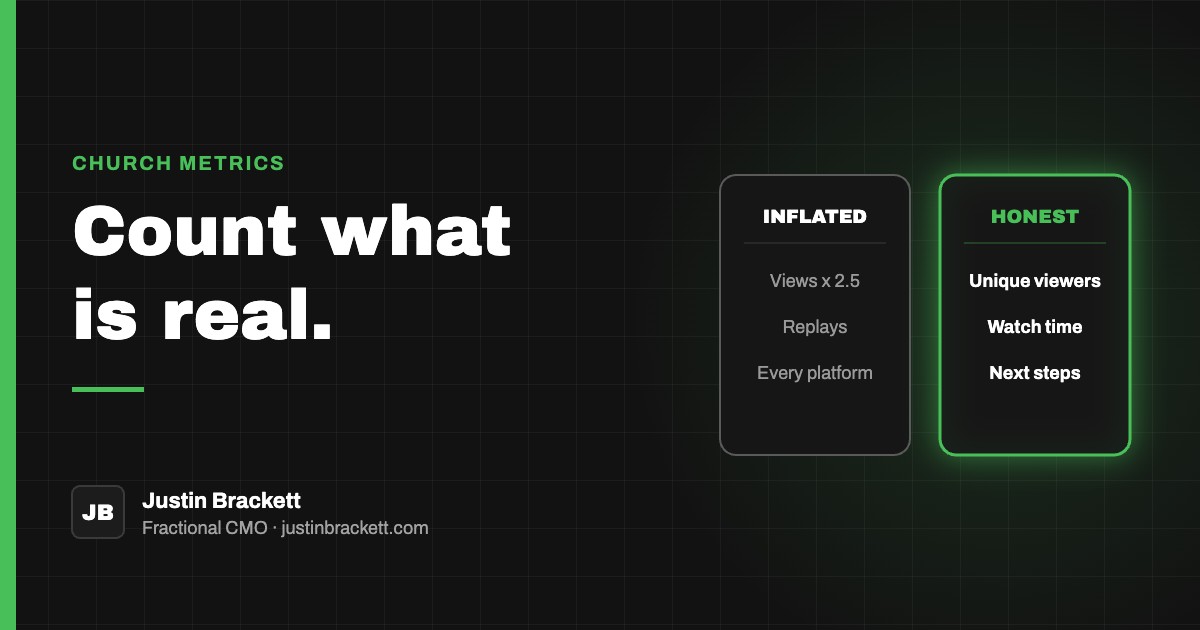
The short answer: the church YouTube metrics a pastor should see every week are 5 numbers: impressions and click-through rate, average view duration, returning viewers, unique viewers, and next steps taken. Views and subscribers alone will mislead you. Multiplying views to count attendance is dishonest.
5 numbers. Same order. Every week.
The first 4 live in YouTube Studio. The 5th one you have to track yourself.
It’s the one that matters most.
For live streams, add peak concurrent viewers. It’s the closest thing to a headcount YouTube gives you.
Because a view isn’t a person.
It’s a play. The same person can watch 3 times. On Facebook, a video view can be a 3-second play (Baptist Press).
Subscribers lag. They tell you what happened months ago.
Neither one tells you if anyone took a step.
No.
It’s dishonest.
I know how it started. “No one watches church alone.” So multiply by 2. Or 2.5. Or 3.
Churches have been doing this for years. In a Christian Standard survey, 49% of churches used a multiplier. The average was 2.03. One megachurch used 3.3 (Christian Standard).
Some denominations even tell churches to add live and replay views together, then multiply the total by 2 (ELCA Pacifica Synod guidance).
Now stack it.
The same family gets counted on YouTube. And on Facebook. And on the website. Live. Then again on replay.
Then the whole thing gets doubled. Or tripled.
A 3-second scroll becomes 2.5 people in worship.
In the building, you count the people in the seats.
Online, the multiplier counts people who were never seen. And it makes the number look better every single week.
Count what you can verify.
If families are watching together, you’ll see it. In next steps. In your lobby. Not in a formula.
No. You need the right 25.
But those 25 are strangers today. They’re searching YouTube for answers, not your church’s name.
You only meet them if a lot more people see you first.
That’s why impressions sit at the top of the scoreboard.
Give every video 1 clear next step. In the description. On screen. Out loud.
Plan a visit. Join a group. Ask for prayer.
Use a trackable link for each one.
Then ask your first-time guests how they found you. And write it down.
That’s the number that tells you YouTube is doing ministry. Not just collecting views.
Weekly. 5 minutes. Same 5 numbers. Same order.
Watch the trend over 8 to 12 weeks, not the swing from 1 Sunday to the next.
Honest numbers lead to better decisions.
Inflated ones just make you feel better.
If you’re not sure who should own this, read who should run your church YouTube. If your numbers say the channel is stuck, go back to the 5 questions. If you want a team that runs your channel and reports honest numbers every week, that’s what we do at digifora.
It depends on the channel and where the impressions come from. Compare each video to your own average and work to raise it over time.
A play of the video, not a person. One person can create several views.
No. Report the numbers you can verify, like unique viewers and peak concurrent viewers.
Use peak concurrent viewers for live streams, unique viewers for the week, and next steps taken. Report them separately from in-person attendance.
Next steps taken. It’s the one that shows viewers becoming part of your church.

Justin has a proven track record of delivering results for clients across a range of industries, including hospitality, technology, retail, and non-profit.
