
 Justin Brackett · November 7, 2026
Someone in your city is going to ask ChatGPT where to go to church this week.
Someone else is going to ask it what the Bible says about anxiety.
Your pastor has answered both.
The question is whether AI knows that.
I’ve rebuilt this site to be found by AI search. And my team at digifora works on YouTube for ministries like Turning Point, Joel Osteen Ministries and Apollos. Here’s what I’d tell any church.
This is part of my series on YouTube for churches.
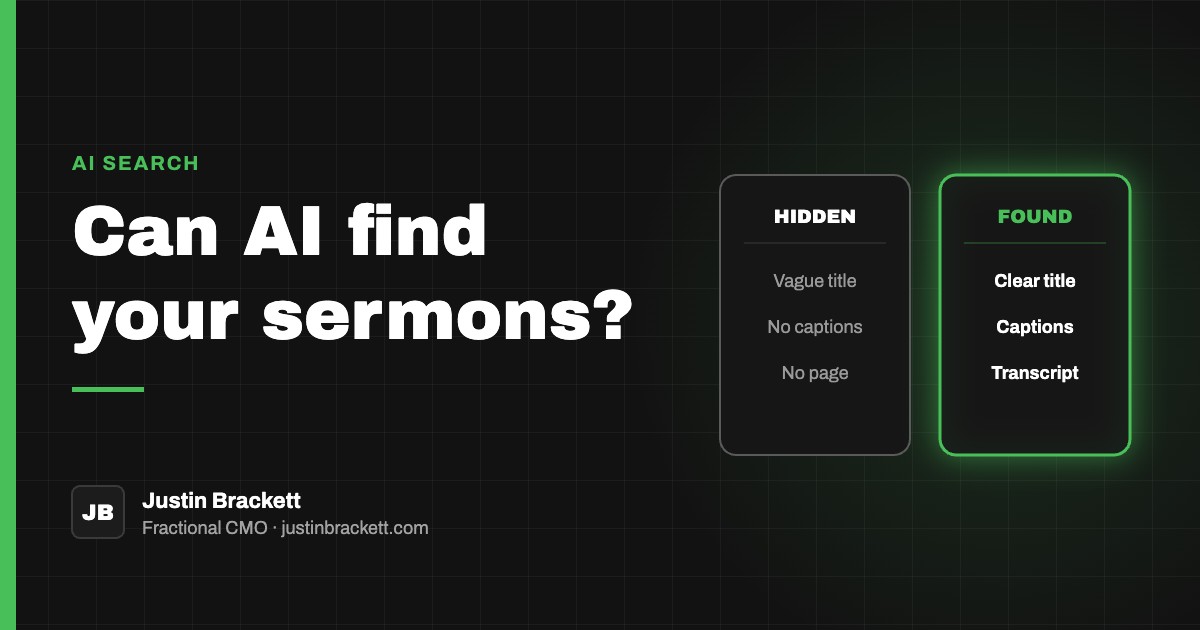
The short answer: AI search engines like ChatGPT, Perplexity and Google AI Overviews answer questions by pulling from pages and videos they can read as text. If your sermons have clear titles, accurate captions, chapters and a transcript on your website, AI can find them, quote them and send people to your church.
They read what they can read as text.
For a sermon, that’s the title. The description. The captions. Any transcript or summary on your website.
A video called “Sunday Service, November 2” with no captions? That gives them almost nothing.
Mostly words.
Titles. Descriptions. Chapter names. Captions.
That’s why everything in YouTube SEO for churches does double duty. The title that wins a YouTube search also gives AI a clear label.
They turn a 40-minute video into something AI can actually search.
Chapters tell it which part answers which question.
A transcript gives it the actual words.
YouTube makes automatic captions. They’re a start. But they miss names, Scripture references and a lot of church words. Fix them. Or upload your own.
Every sermon gets its own page. Not just a grid of embeds.
Your website is where AI goes to check its answer. Give it one.
It’s worth an hour.
llms.txt is a simple text file that points AI tools to your most important pages. It’s still a proposed standard, and not every AI company says it uses one.
But it’s free. I run one on this site.
Check. Seriously.
A lot of church sites block AI crawlers without knowing it. A security plugin. A host setting.
If you want to be found, let in the crawlers AI search uses, like OAI-SearchBot for ChatGPT search and PerplexityBot for Perplexity.
And verify your site in Bing Webmaster Tools. Part of ChatGPT’s search draws on Bing.
Because churches are vague.
AI repeats what it can confirm. If your website is fuzzy about your denomination, what you believe or when you meet, AI fills in the blanks. Sometimes wrong.
Say it plainly. On your site. In your Google Business Profile.
Ask it.
Open ChatGPT, Perplexity, Gemini and Google. Ask these 10. Write down what you find. Do it again every month.
If the answers are wrong or missing, the fix is almost always your website and your YouTube titles. Not the AI.
Then track what changes on your church YouTube scoreboard.
People are already asking AI about faith. About church. About God.
Make sure your church is part of the answer.
If you want help building the plan, let’s talk. If you want a team doing the work every week, that’s what we do at digifora.
It can find what it can read as text: titles, descriptions, captions and transcripts. Clear titles and transcripts on your website make that much more likely.
Answer engine optimization: structuring your pages and videos so search features and AI tools can pull a direct answer from them.
Yes. Captions turn speech into text that search engines and AI tools can read. Correct the automatic ones.
It’s a low-cost addition. It’s a proposed standard, so treat it as a bonus, not the main strategy.
Ask ChatGPT, Perplexity, Gemini and Google the same 10 questions every month and record the answers.

Justin has a proven track record of delivering results for clients across a range of industries, including hospitality, technology, retail, and non-profit.
